

Go inside a robotic polishing system. Learn how the 6-axis robot arm, force control polishing systems, and software deliver a perfect finish on complex stone.
TL;DR: How Does a Polishing Robot Actually Work?

  • It's a complete system, not just an arm. A stone polishing robot combines a 6-axis industrial arm, a specialized force-control polishing head, and intelligent software to work as a single unit.
  • Force control is the secret. Unlike rigid CNC machines, the robot can "feel" the surface and maintain constant pressure, which is crucial for a perfect, swirl-free finish on curves and contours.
  • Software runs the show. Paths are generated from 3D models (CAD/scans), allowing the robot to precisely follow complex geometries that are impossible for manual polishers or simpler machines.
  • It's built for industrial use. This is stationary factory equipment requiring a reinforced foundation, three-phase power, and a comprehensive safety cell, including physical guarding and sensors.
Have technical questions about integration?Schedule a call with our automation specialists.

打磨机械手.webpWhat is a Robotic Polishing System, Really?
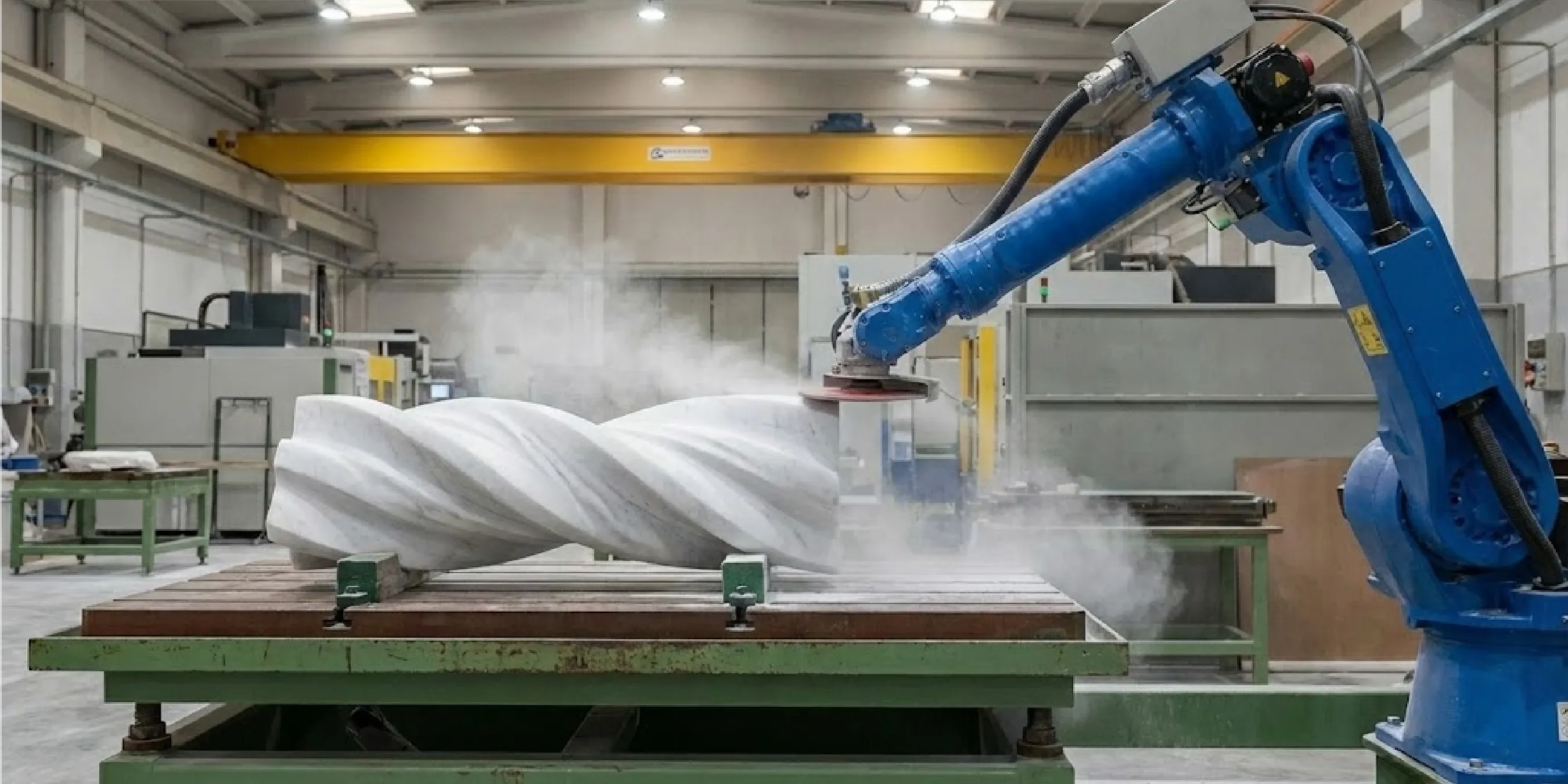
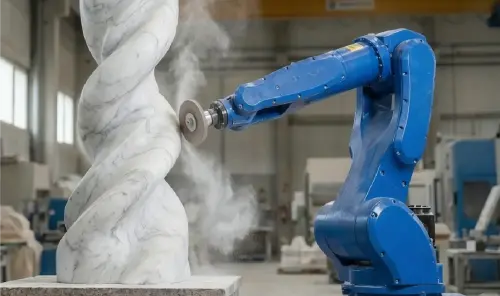
A robotic stone polishing system is an integrated solution designed for high-precision surface finishing. It's fundamentally different from a standard CNC machine. While a CNC follows a rigid, pre-defined path, a robotic system is more like a highly skilled artisan's arm—one that never gets tired and repeats its motions with microscopic accuracy thanks to its core stone polishing robot technology.
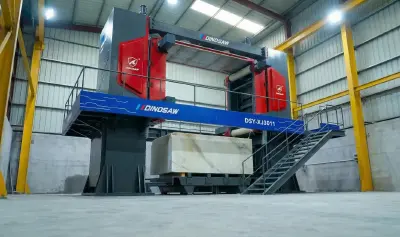
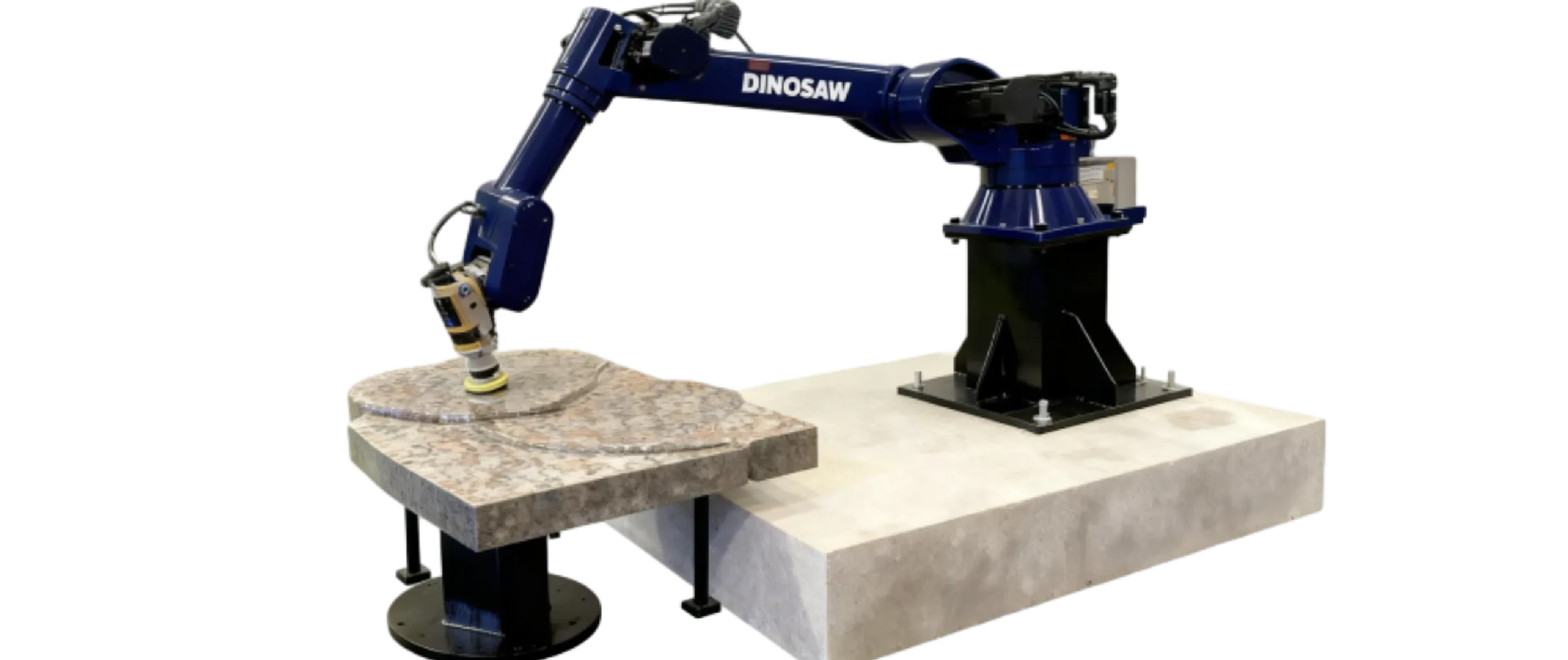
The system consists of three main pillars: a multi-axis industrial robot for dexterity, an active force control polishing head that provides the sense of "touch," and sophisticated software that translates a 3D design into a perfect finish. This combination is what allows it to master the complex, curved surfaces of sinks, statues, and custom furniture, where traditional automation falls short. The DINOSAW Robotic Polishing Arm integrates these key technologies into a robust factory solution.

5@1.5x.webpAnatomy of a Robotic Polishing System: Core Components
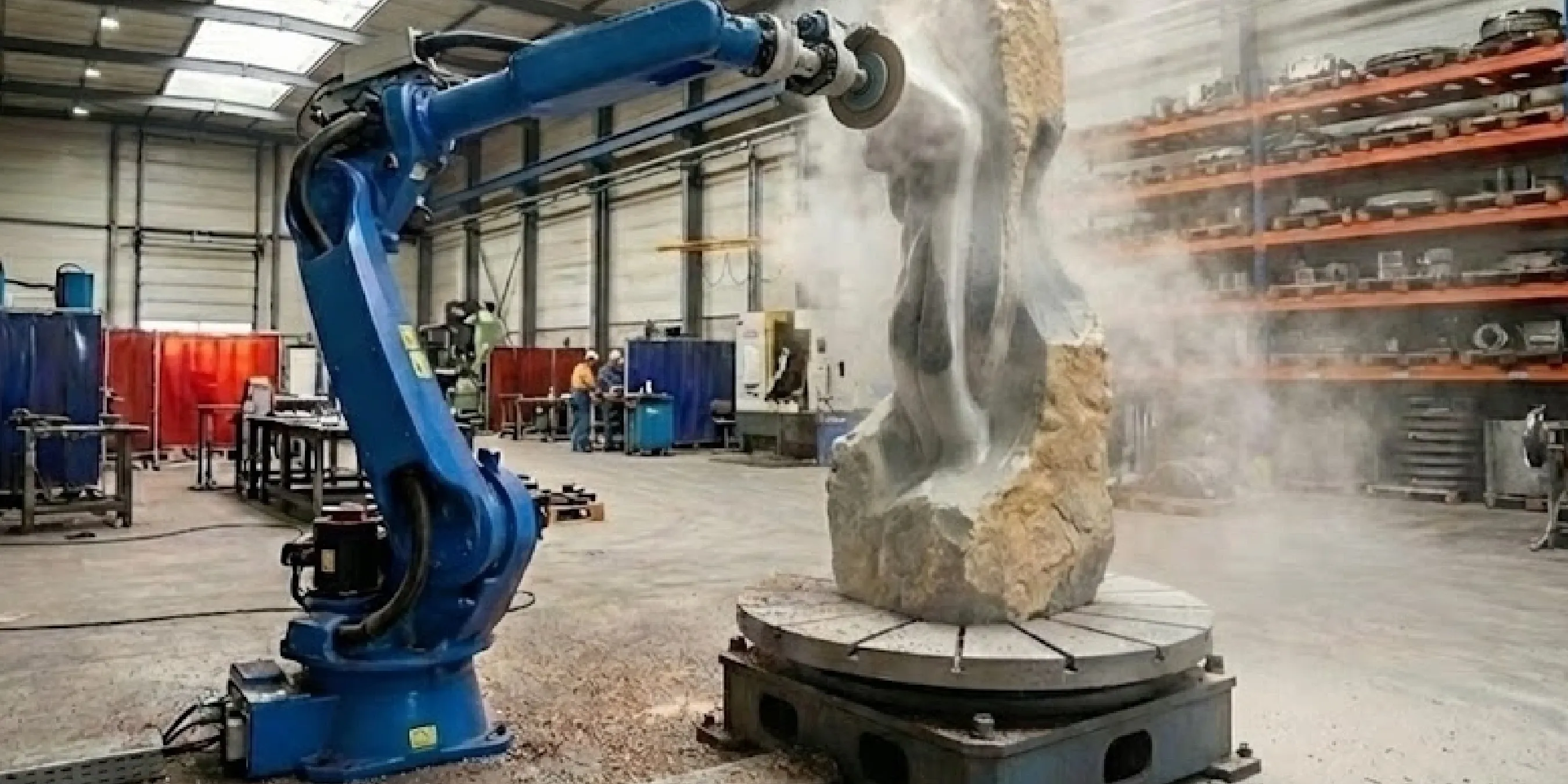
Understanding how the system achieves its results means looking at each component's role.
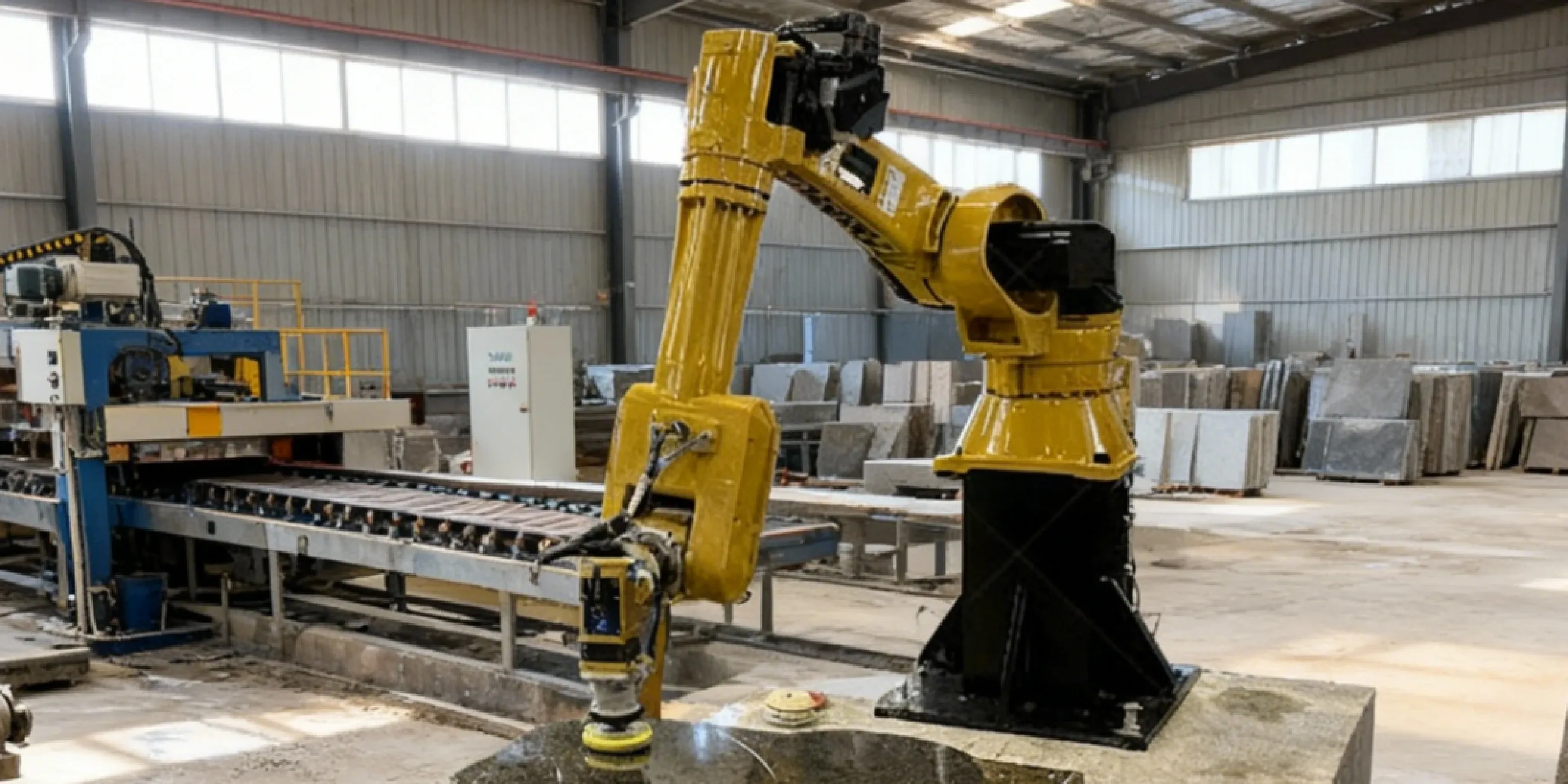
  • 1. The 6-Axis Robot Arm: This is the backbone of the system. Its six axes of rotation give it incredible flexibility to reach complex angles and internal surfaces. Key specs include payload (to handle the weight of the polishing head) and reach (to cover large workpieces). Manufacturer-reported path repeatability is often in the range of ±0.05mm, ensuring consistent tool placement.
  • 2. Active Force Control System: This is the system's "superpower." A sensor in the polishing head constantly measures the force being applied to the stone surface. The robot's controller uses this feedback to adjust its position in real-time (often thousands of times per second) to maintain a preset force, typically between 10-100N [TBD]. This is what eliminates swirl marks and ensures a uniform gloss, even on uneven or curved surfaces.
  • 3. High-Frequency Spindle & Polishing Head: The spindle spins the abrasive pads at optimal speeds for stone polishing. The head itself is designed to hold various polishing pads and often includes an integrated water feed to cool the surface and manage dust. An automatic tool changer allows the robot to cycle through different grits, from coarse grinding to final buffing, without manual intervention.
  • 4. Control System & Software: This is the brain. Modern systems use intuitive software that can import a 3D model (e.g., from a STEP file or 3D scan) and automatically generate the complex polishing paths. Operators can then use a simulation environment to verify the path and tool angles before ever touching the stone, minimizing the risk of collision or error.
  • 5. Safety & Environmental Systems: No industrial robot operates in open space. A complete work cell includes safety fencing, light curtains or area scanners, and interlocking gates that automatically stop the robot if a person enters the area. This is mandated by safety standards like ISO 10218. Additionally, a robust water and slurry management system is essential for collecting and recycling water and safely disposing of stone dust.

11@1.5x.webpRobot vs. CNC Polishing: Which Performs Better?

The primary advantage is adaptive consistency. A human can't maintain the exact same pressure for eight hours. A CNC can't adapt to a slight surface variation. A robot can do both.
Factor
Robotic Polishing System
Traditional Methods (Manual/Simple CNC)
Quality on 3D Surfaces
Exceptional. Force control ensures a perfect, uniform finish on curves, corners, and complex geometries.
Highly variable. Prone to swirl marks, uneven gloss, and operator fatigue. CNCs struggle with non-flat surfaces.
Repeatability
Near-perfect. Every piece is polished identically, enabling true mass customization and reliable quality control.
Low. No two manually polished pieces are exactly the same.
Labor Requirement
Reduces reliance on highly skilled (and scarce) artisans. One operator can often supervise multiple cells.
Requires highly skilled, experienced polishers who are physically engaged throughout the process.
Data for QC
The system can log all process parameters (force, speed, cycle time) for every job, creating a digital quality record.
No data logging. Quality control is based on visual inspection only.

System Compatibility: Integrating with Your Workshop

A robot polishing machine is designed to integrate into a modern digital fabrication workflow. Compatibility is key:
  • CAD/CAM Software: Most systems can directly import standard 3D file formats like STEP, IGES, and STL. The robot's software then uses this model to generate the toolpaths. Some can also work with 2D DXF files for edge polishing.
  • 3D Scanning: For unique or artistic pieces without a CAD model, a 3D scanner can be used to create a digital twin of the object, which the robot can then be programmed to polish.
  • Factory Automation Protocols: The robot controller can communicate with other machines and the factory's main PLC using standard protocols like Profinet, EtherNet/IP, or OPC UA, enabling fully automated production lines.

3@1.5x.webpFrequently Asked Questions (FAQ)

How does force control polishing work?

In simple terms, it allows the robot to "feel" and adapt to the stone's surface.
  • Mechanism: A load cell in the polishing head measures the force applied to the stone in real-time. The robot's controller instantly compares this to the programmed force (e.g., 45N) and makes micro-adjustments to the arm's position thousands of times per second to maintain it.
  • Parameters: Operators set a target force (e.g., 10-100N) and stiffness. This allows the polishing pad to effectively "float" over the surface with constant pressure, absorbing minor variations.
  • Next Step: To see this technology in action, review the specifications of the DINOSAW Robotic Polishing Arm.

What are the maintenance requirements for a robot polishing machine?

Maintenance is scheduled and preventative, similar to other critical CNC machinery.
  • Checklist:
    • Daily: Cleaning, visual checks for leaks.
    • Weekly: Greasing specific joints, checking cable wear.
    • Annually: Professional service including brake checks, oil changes, and full calibration.
  • Risk: Neglecting the maintenance schedule is the fastest way to cause unplanned downtime and costly repairs.
  • Next Step: Download our detailed Robotic Polisher Maintenance Checklist  to establish your own SOP.

Can the system integrate with my CAD/CAM for robotic polishing?

Yes, integration is a core feature of modern robotic polishing systems.
  • Context: The workflow involves exporting a 3D model from your CAD software, which the robot's CAM software then uses to generate toolpaths.
  • Parameters: Standard file formats like STEP, IGES, or STL are universally supported. Some robot manufacturers also offer direct plugins for popular CAM software (e.g., Mastercam, Fusion 360), which can streamline the process.
  • Next Step: For more on how different machines fit into a digital workflow, read our guide on CNC Stone Machines Explained.

What happens to the 6-axis robot arm if power is lost?

The robot freezes safely in place; it does not drop or go limp.
  • Mechanism: Powerful brakes on all six axes engage instantly upon power loss, locking the arm's position. This is a fundamental safety feature.
  • Recovery Process: When power is restored, the controller allows the operator to perform a controlled recovery. This usually involves manually "jogging" the robot back to its home position before restarting the program. Modern controllers can often resume the program from the exact point of interruption.
  • Risk: The primary risk is not damage to the robot, but potential scarring on the workpiece if the polishing pad stops while in contact. Proper recovery procedures mitigate this.

How do you troubleshoot issues like swirl marks?

Swirl marks are almost always a process parameter issue, not a machine fault.
  • Context: This issue indicates that the abrasive is not breaking down correctly, leaving visible traces of its path.
  • Parameters to Adjust:
    • Reduce the applied force setting (e.g., from 40N down to 30N ).
    • Decrease the spindle speed (RPM).
    • Increase the path overlap (step-over), e.g., from 50% to 75%.
    • Ensure adequate water flow.
  • Next Step: For detailed parameter starting points, refer to our Pro Fabricator’s Polishing Guide.

What are the key robotic polishing safety standards?

Yes, the entire work cell must be designed and certified to meet stringent international and regional safety standards.
  • Governing Standard: The primary global standard is ISO 10218 ("Safety requirements for industrial robots"), which mandates risk assessments, safety-rated controls, and protective measures.
  • Required Measures: This includes physical guarding (fencing), safety interlocks on access gates, light curtains or area scanners, and redundant emergency stop circuits.
  • Regional Compliance: In the US, the system must also align with regulations from OSHA, particularly regarding electrical safety and control of hazardous energy (LOTO).
  • Next Step: When purchasing a system, ensure the integrator provides a Declaration of Conformity certifying the entire cell meets these standards.